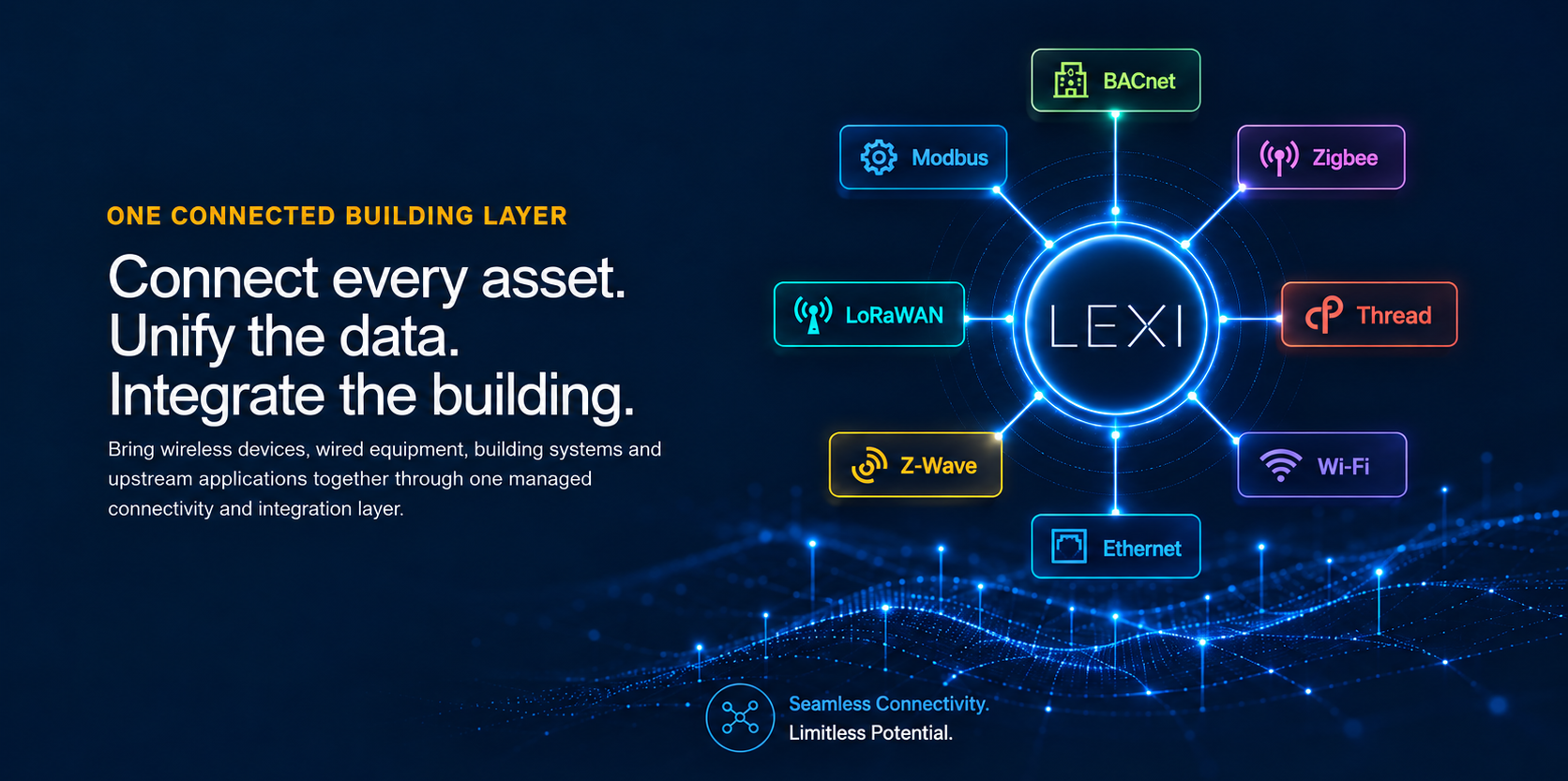
One connected building layer — connect every asset, unify the data, integrate the building. Bring wireless devices, wired equipment, building systems and upstream applications together through one managed connectivity and integration layer: BACnet, Modbus, Zigbee, LoRaWAN, Thread, Z-Wave, Wi-Fi and Ethernet. Seamless connectivity, limitless potential.
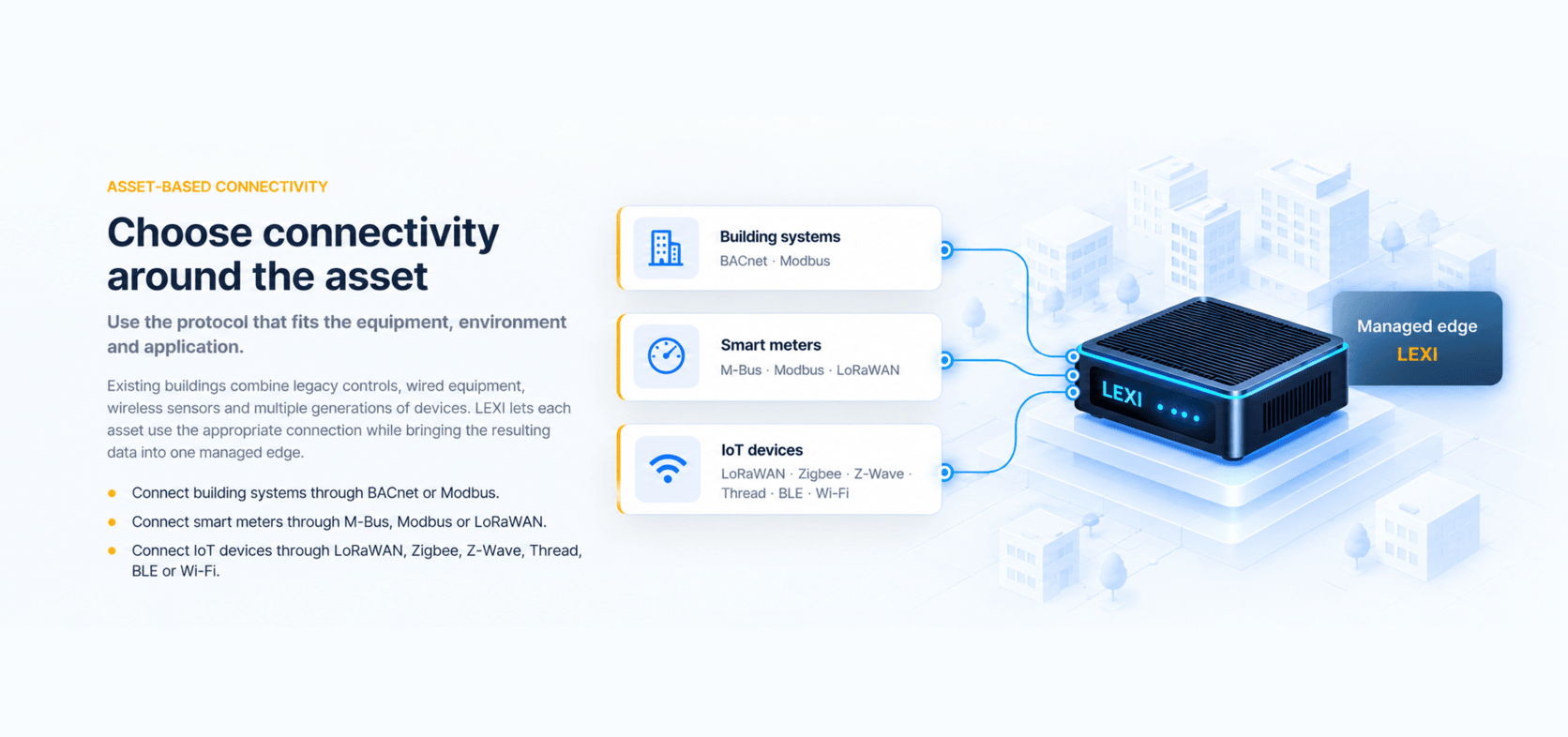
Asset-based connectivity — choose connectivity around the asset. Use the protocol that fits the equipment, environment and application. Existing buildings combine legacy controls, wired equipment, wireless sensors and multiple generations of devices. LEXI lets each asset use the appropriate connection while bringing the resulting data into one managed edge. Connect building systems through BACnet or Modbus. Connect smart meters through M-Bus, Modbus or LoRaWAN. Connect IoT devices through LoRaWAN, Zigbee, Z-Wave, Thread, BLE or Wi-Fi.
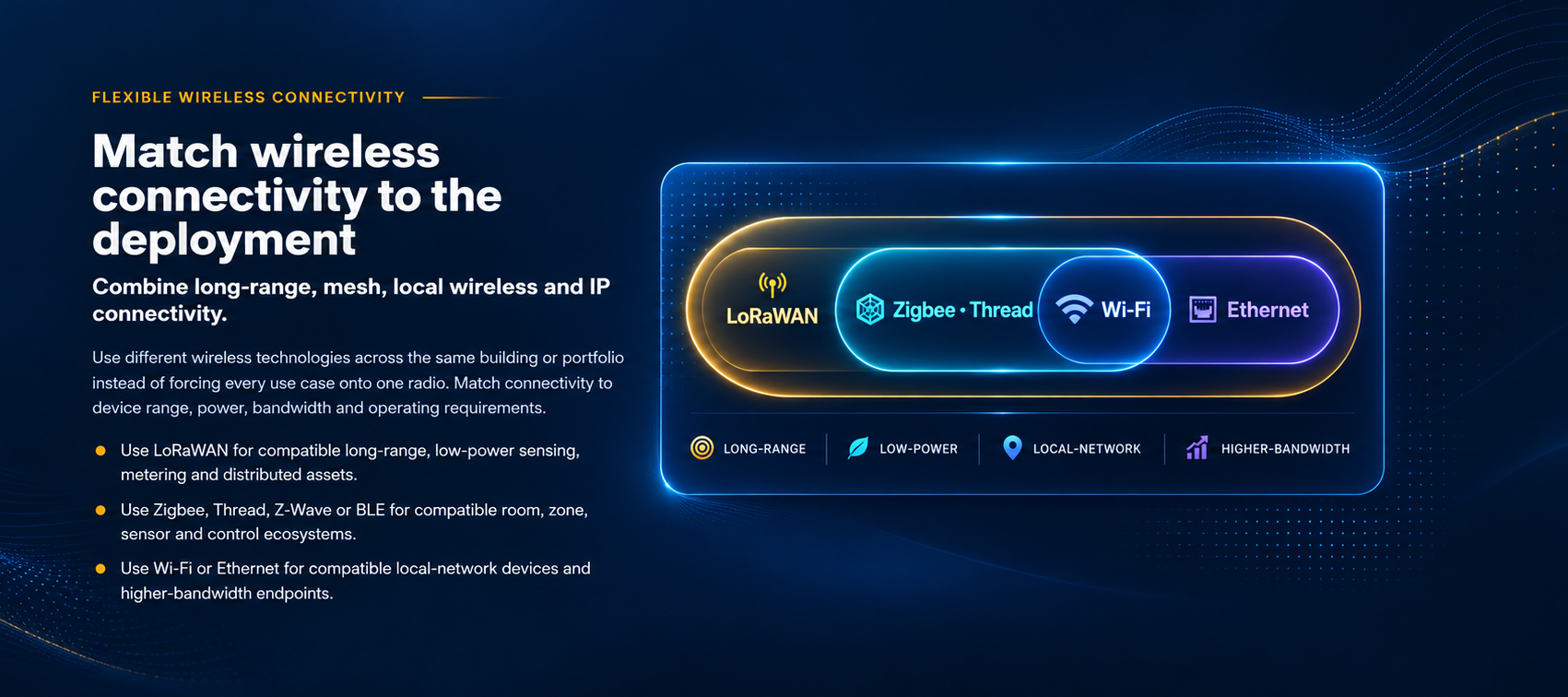
Flexible wireless connectivity — match wireless connectivity to the deployment. Combine long-range, mesh, local wireless and IP connectivity. Use different wireless technologies across the same building or portfolio instead of forcing every use case onto one radio. Match connectivity to device range, power, bandwidth and operating requirements. Use LoRaWAN for compatible long-range, low-power sensing, metering and distributed assets. Use Zigbee, Thread, Z-Wave or BLE for compatible room, zone, sensor and control ecosystems. Use Wi-Fi or Ethernet for compatible local-network devices and higher-bandwidth endpoints.
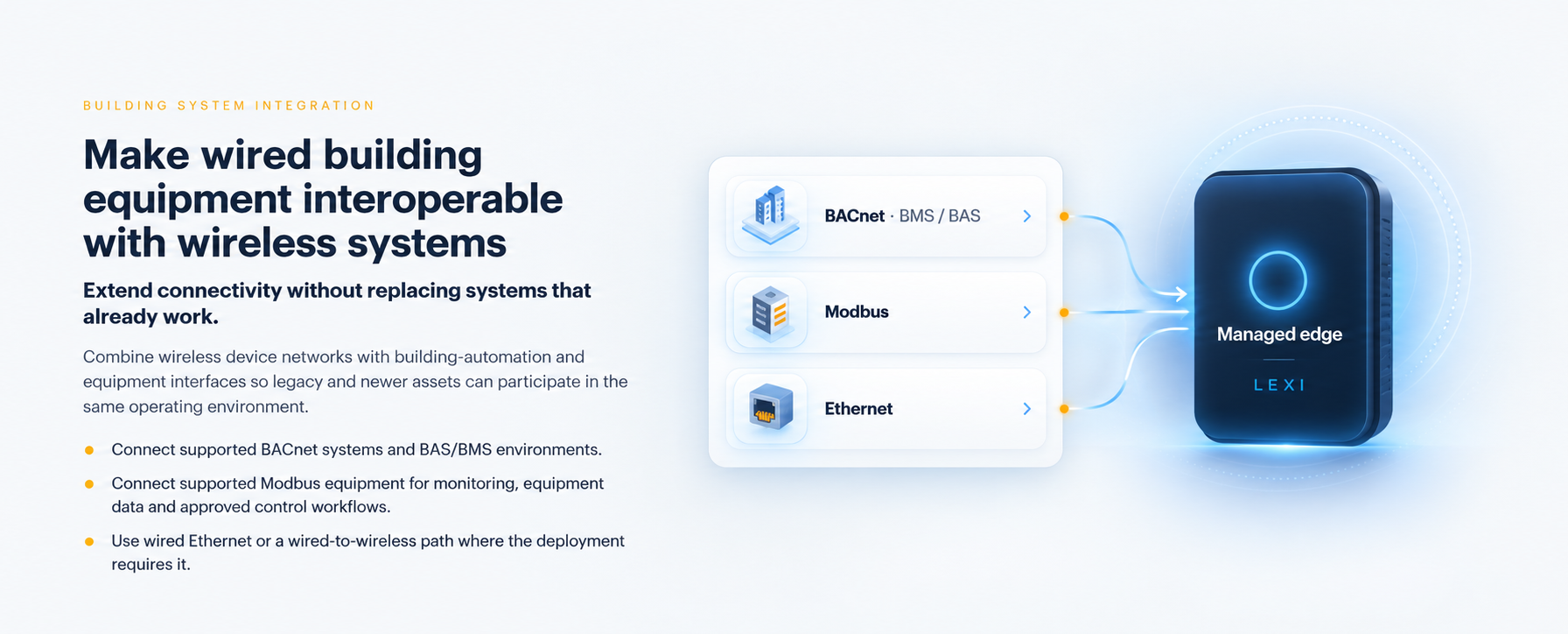
Building system integration — make wired building equipment interoperable with wireless systems. Extend connectivity without replacing systems that already work. Combine wireless device networks with building-automation and equipment interfaces so legacy and newer assets can participate in the same operating environment. Connect supported BACnet systems and BAS/BMS environments. Connect supported Modbus equipment for monitoring, equipment data and approved control workflows. Use wired Ethernet or a wired-to-wireless path where the deployment requires it.
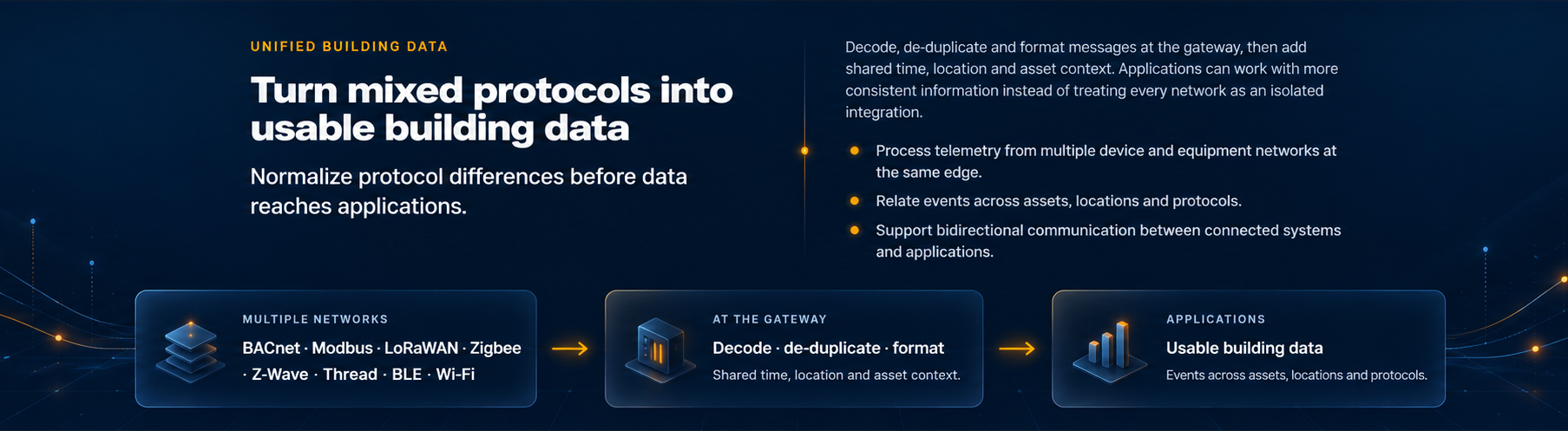
Unified building data — turn mixed protocols into usable building data. Normalize protocol differences before data reaches applications. Decode, de-duplicate and format messages at the gateway, then add shared time, location and asset context. Applications can work with more consistent information instead of treating every network as an isolated integration. Process telemetry from multiple device and equipment networks at the same edge. Relate events across assets, locations and protocols. Support bidirectional communication between connected systems and applications. Flow: multiple networks (BACnet, Modbus, LoRaWAN, Zigbee, Z-Wave, Thread, BLE, Wi-Fi) to the gateway (decode, de-duplicate, format with shared time, location and asset context) to applications (usable building data across assets, locations and protocols).
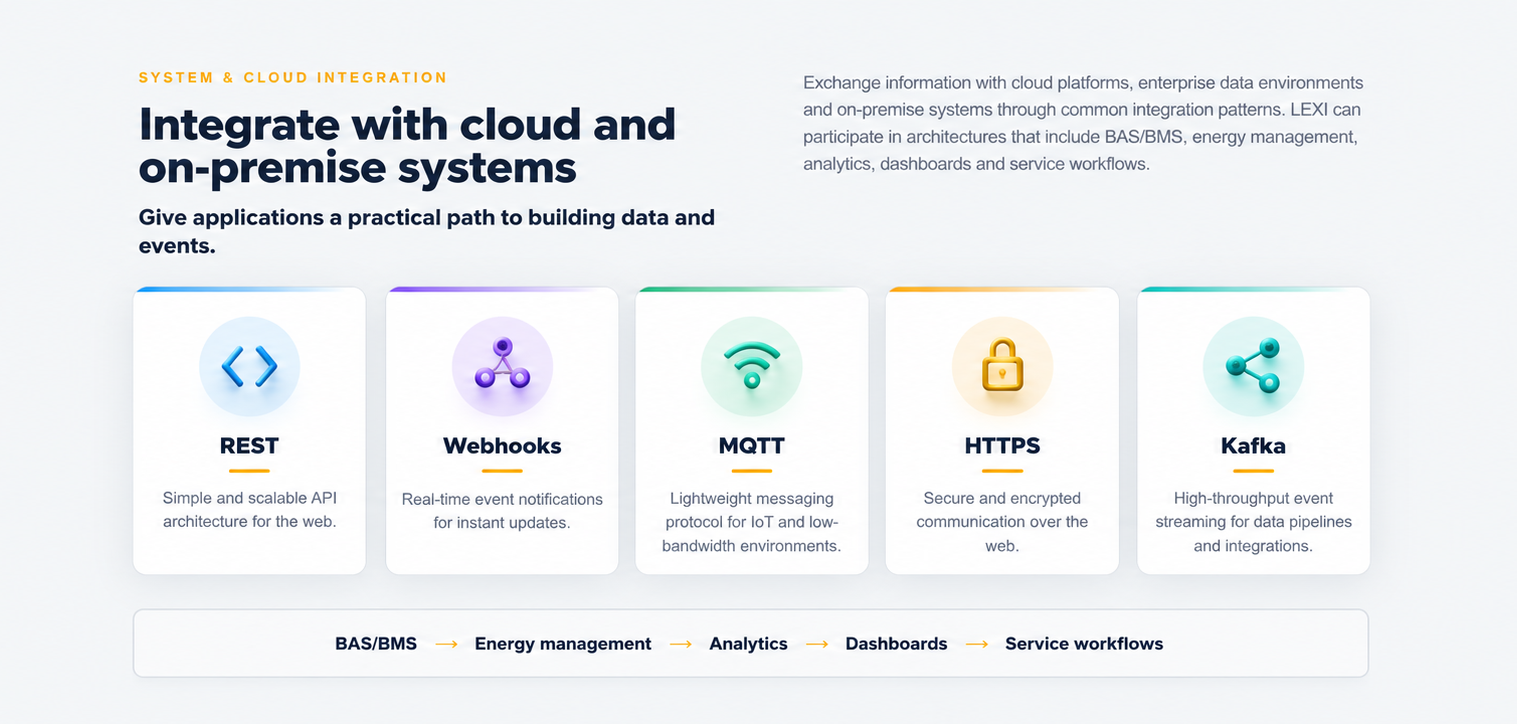
System & cloud integration — integrate with cloud and on-premise systems. Give applications a practical path to building data and events. Exchange information with cloud platforms, enterprise data environments and on-premise systems through common integration patterns. LEXI can participate in architectures that include BAS/BMS, energy management, analytics, dashboards and service workflows. REST: simple and scalable API architecture for the web. Webhooks: real-time event notifications for instant updates. MQTT: lightweight messaging protocol for IoT and low-bandwidth environments. HTTPS: secure and encrypted communication over the web. Kafka: high-throughput event streaming for data pipelines and integrations. Flow: BAS/BMS, energy management, analytics, dashboards, service workflows.
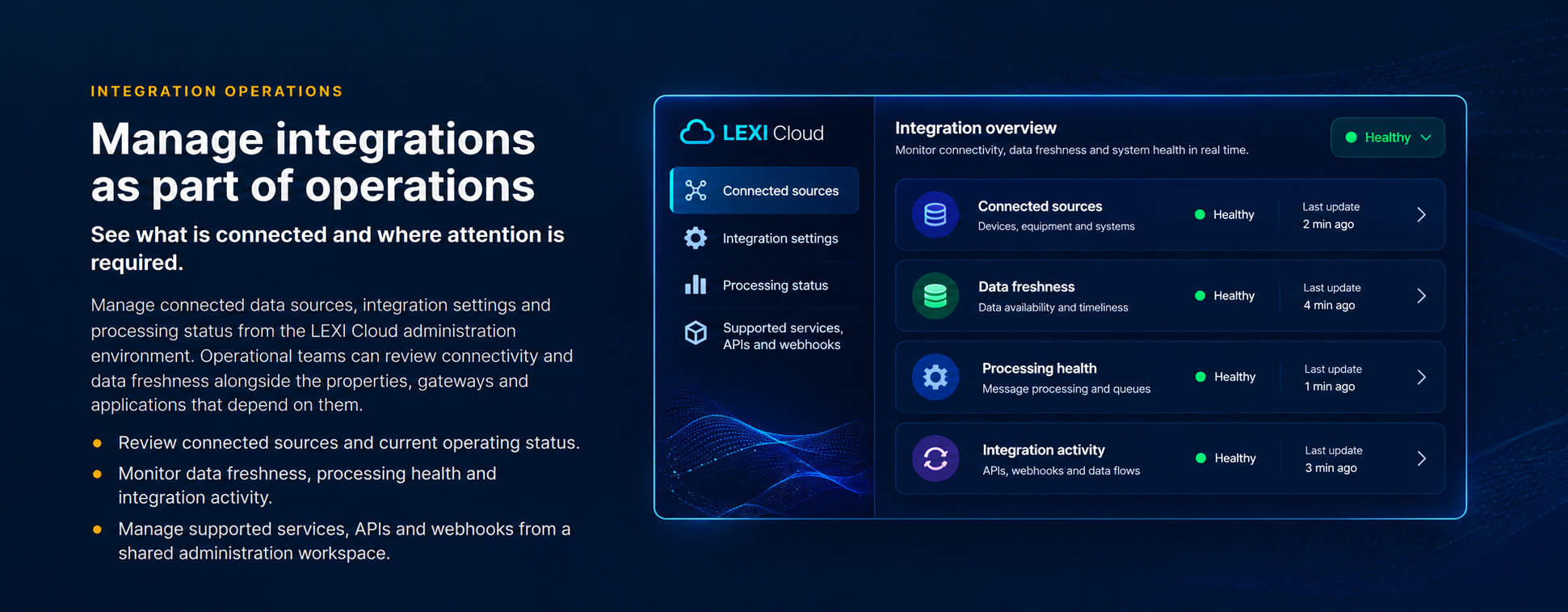
Integration operations — manage integrations as part of operations. See what is connected and where attention is required. Manage connected data sources, integration settings and processing status from the LEXI Cloud administration environment. Operational teams can review connectivity and data freshness alongside the properties, gateways and applications that depend on them. Review connected sources and current operating status. Monitor data freshness, processing health and integration activity. Manage supported services, APIs and webhooks from a shared administration workspace.
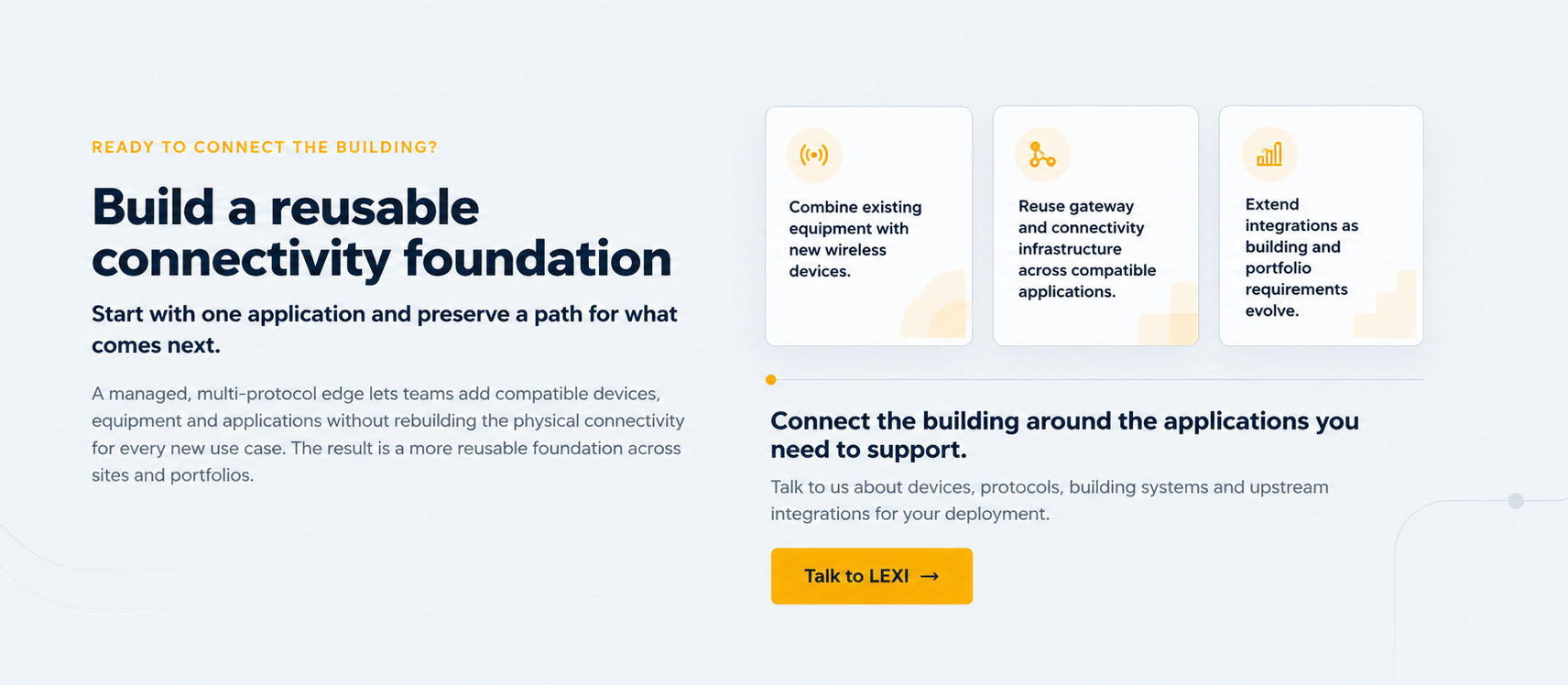
Ready to connect the building? Build a reusable connectivity foundation. Start with one application and preserve a path for what comes next. A managed, multi-protocol edge lets teams add compatible devices, equipment and applications without rebuilding the physical connectivity for every new use case. The result is a more reusable foundation across sites and portfolios. Combine existing equipment with new wireless devices. Reuse gateway and connectivity infrastructure across compatible applications. Extend integrations as building and portfolio requirements evolve. Connect the building around the applications you need to support. Talk to us about devices, protocols, building systems and upstream integrations for your deployment.