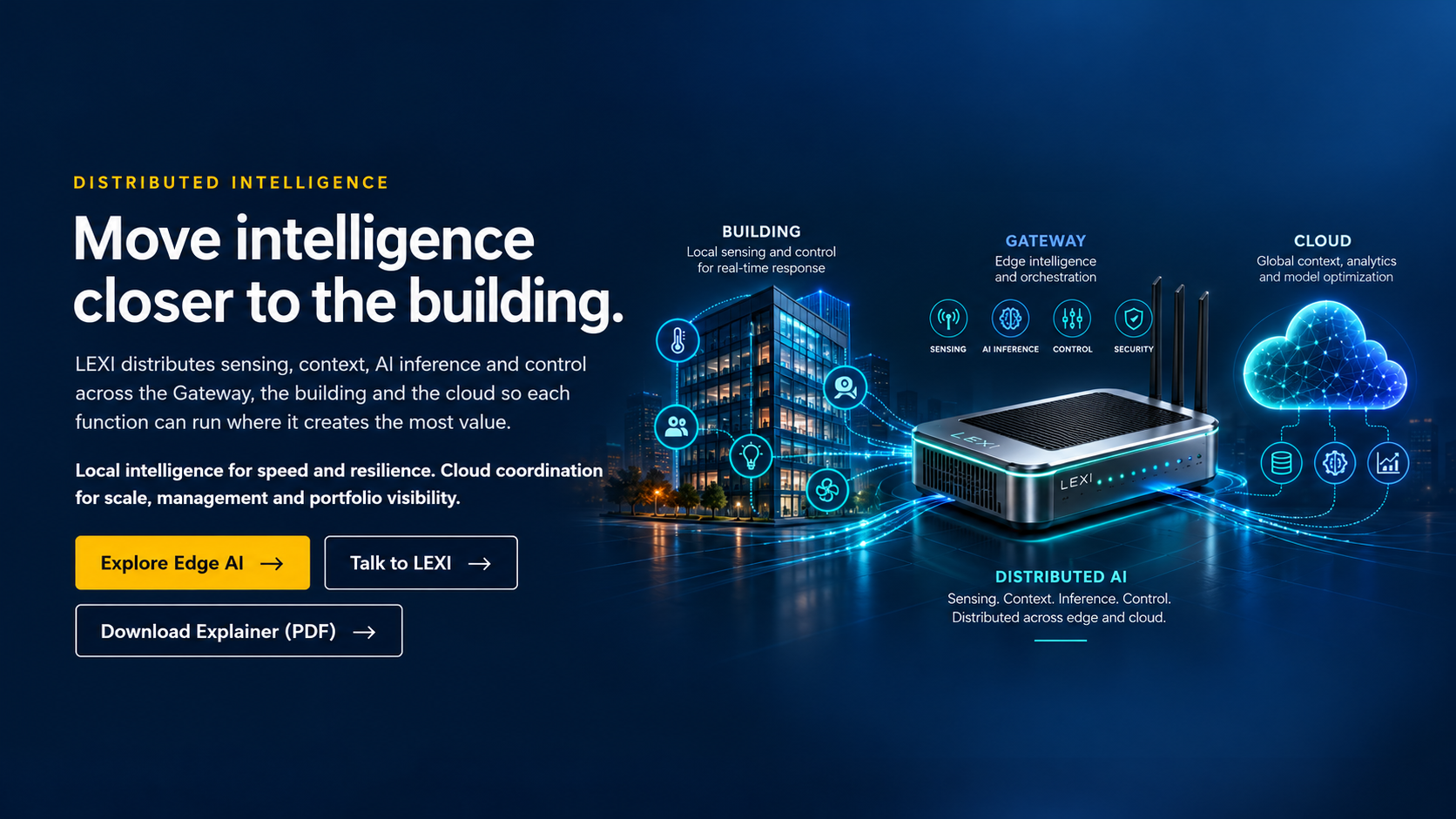
Distributed Intelligence — move intelligence closer to the building. LEXI distributes sensing, context, AI inference and control across the Gateway, the building and the cloud so each function can run where it creates the most value. Local intelligence for speed and resilience. Cloud coordination for scale, management and portfolio visibility. Building: local sensing and control for real-time response. Gateway: edge intelligence and orchestration. Cloud: global context, analytics and model optimization.
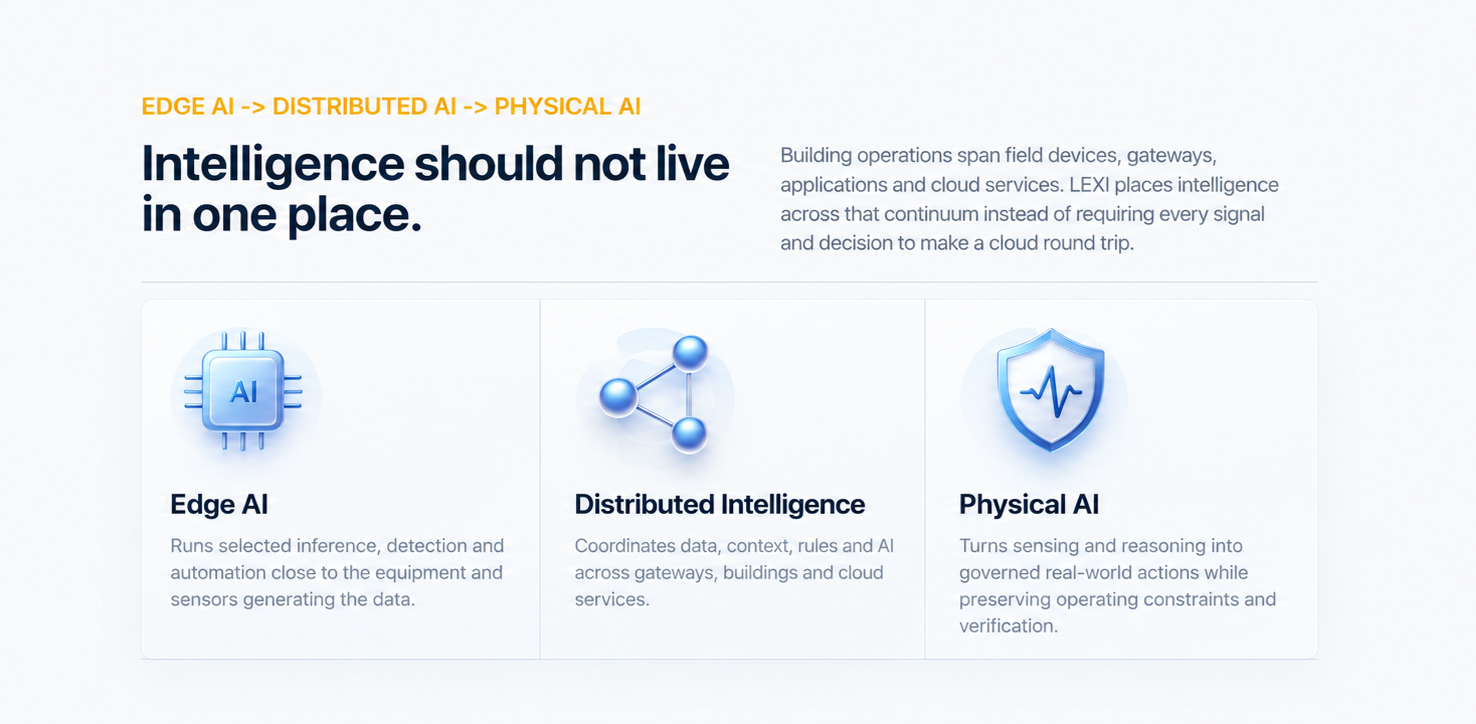
Edge AI, Distributed AI, Physical AI — intelligence should not live in one place. Building operations span field devices, gateways, applications and cloud services. LEXI places intelligence across that continuum instead of requiring every signal and decision to make a cloud round trip. Edge AI runs selected inference, detection and automation close to the equipment and sensors generating the data. Distributed Intelligence coordinates data, context, rules and AI across gateways, buildings and cloud services. Physical AI turns sensing and reasoning into governed real-world actions while preserving operating constraints and verification.
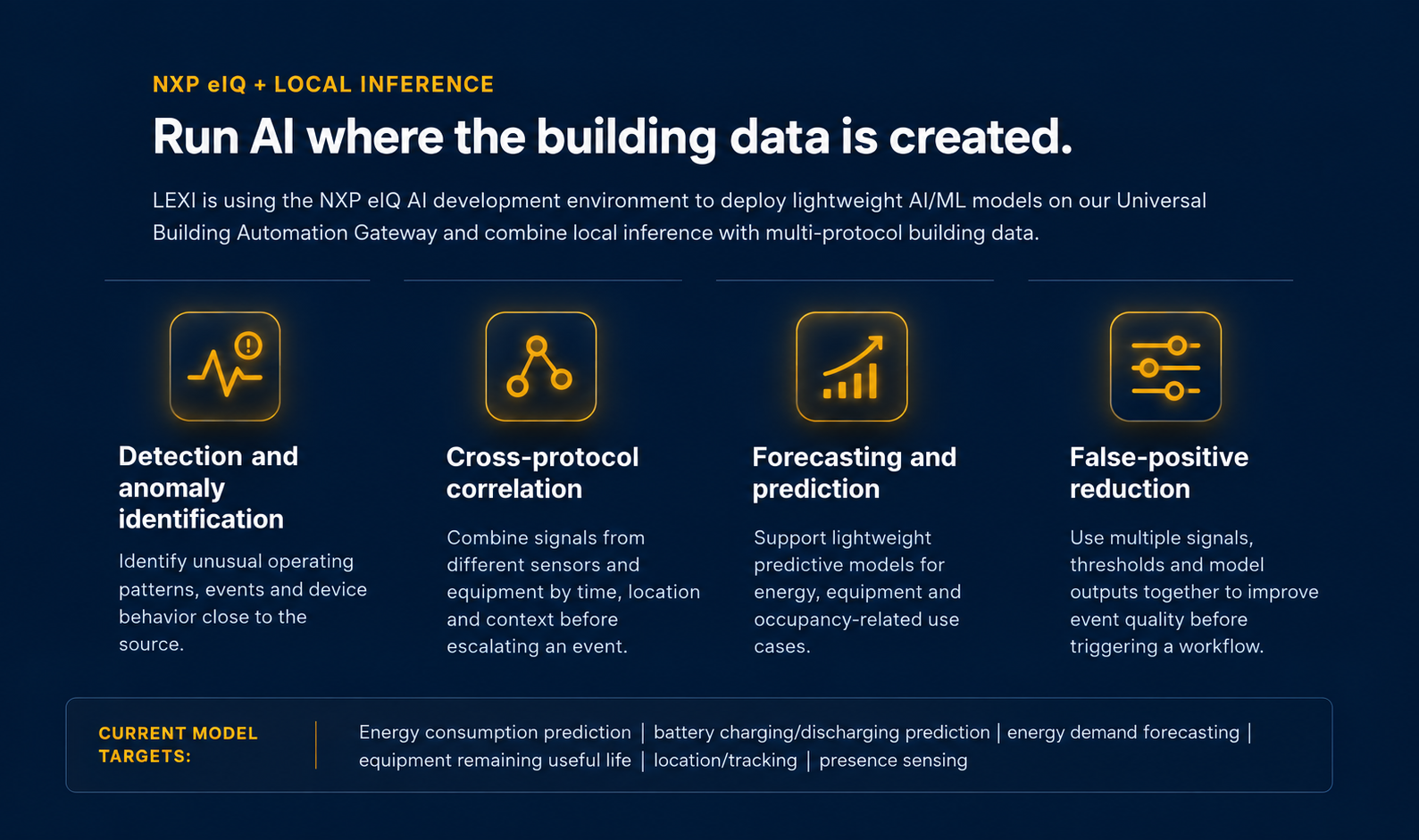
NXP eIQ + local inference — run AI where the building data is created. LEXI is using the NXP eIQ AI development environment to deploy lightweight AI/ML models on our Universal Building Automation Gateway and combine local inference with multi-protocol building data. Detection and anomaly identification: identify unusual operating patterns, events and device behavior close to the source. Cross-protocol correlation: combine signals from different sensors and equipment by time, location and context before escalating an event. Forecasting and prediction: support lightweight predictive models for energy, equipment and occupancy-related use cases. False-positive reduction: use multiple signals, thresholds and model outputs together to improve event quality before triggering a workflow. Current model targets: energy consumption prediction, battery charging/discharging prediction, energy demand forecasting, equipment remaining useful life, location/tracking, presence sensing.
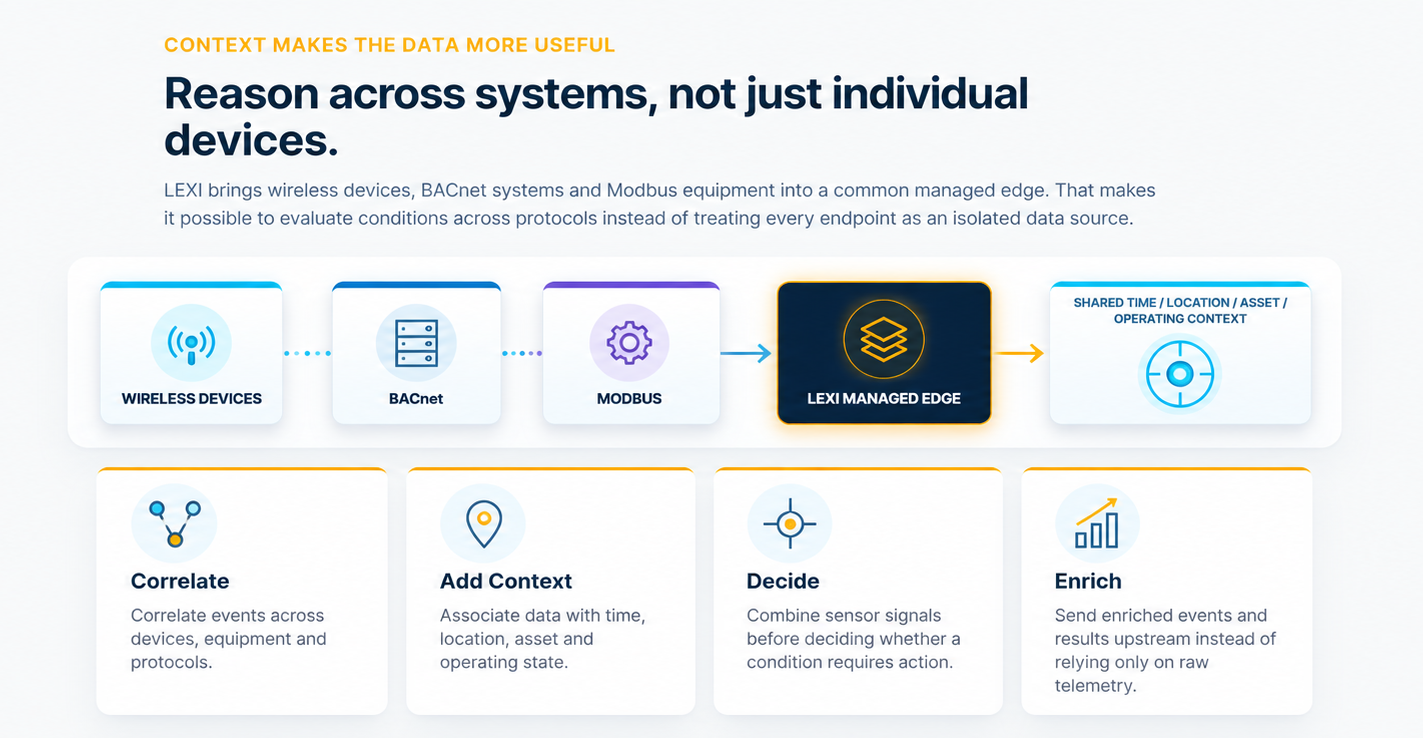
Context makes the data more useful — reason across systems, not just individual devices. LEXI brings wireless devices, BACnet systems and Modbus equipment into a common managed edge. That makes it possible to evaluate conditions across protocols instead of treating every endpoint as an isolated data source. Flow: wireless devices, BACnet and Modbus into the LEXI Managed Edge, producing shared time, location, asset and operating context. Correlate events across devices, equipment and protocols. Add context: associate data with time, location, asset and operating state. Decide: combine sensor signals before deciding whether a condition requires action. Enrich: send enriched events and results upstream instead of relying only on raw telemetry.
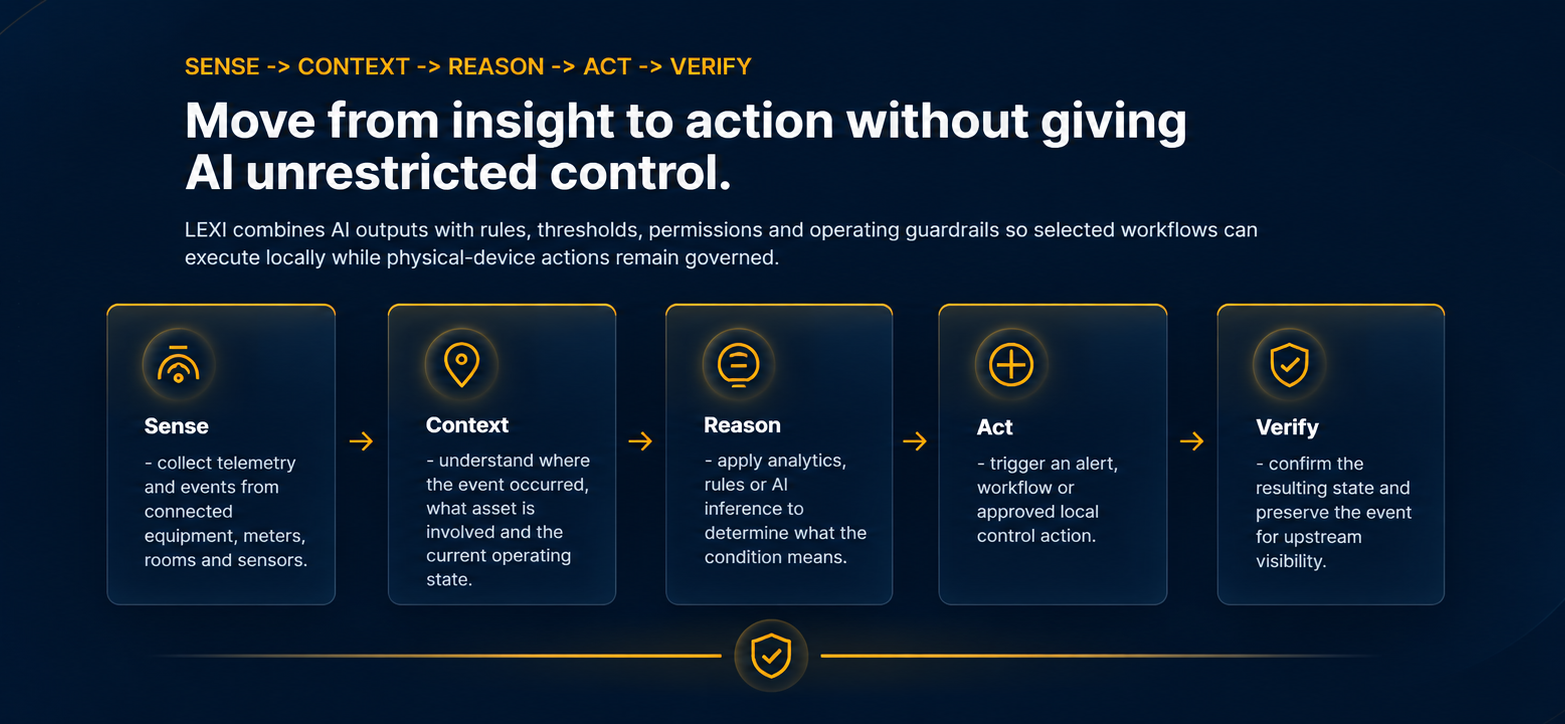
Sense, context, reason, act, verify — move from insight to action without giving AI unrestricted control. LEXI combines AI outputs with rules, thresholds, permissions and operating guardrails so selected workflows can execute locally while physical-device actions remain governed. Sense: collect telemetry and events from connected equipment, meters, rooms and sensors. Context: understand where the event occurred, what asset is involved and the current operating state. Reason: apply analytics, rules or AI inference to determine what the condition means. Act: trigger an alert, workflow or approved local control action. Verify: confirm the resulting state and preserve the event for upstream visibility.
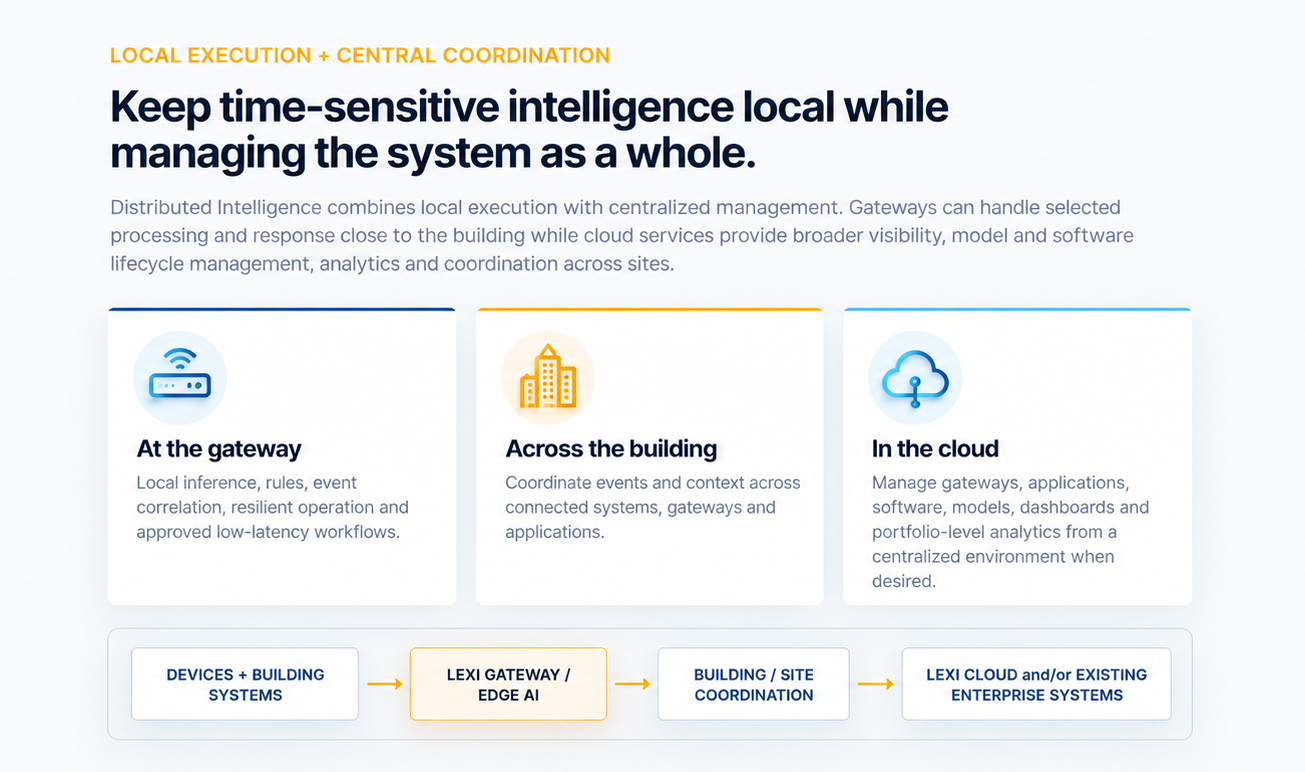
Local execution + central coordination — keep time-sensitive intelligence local while managing the system as a whole. Distributed Intelligence combines local execution with centralized management. Gateways can handle selected processing and response close to the building while cloud services provide broader visibility, model and software lifecycle management, analytics and coordination across sites. At the gateway: local inference, rules, event correlation, resilient operation and approved low-latency workflows. Across the building: coordinate events and context across connected systems, gateways and applications. In the cloud: manage gateways, applications, software, models, dashboards and portfolio-level analytics from a centralized environment when desired. Flow: devices + building systems to LEXI Gateway / Edge AI to building / site coordination to LEXI Cloud and/or existing enterprise systems.
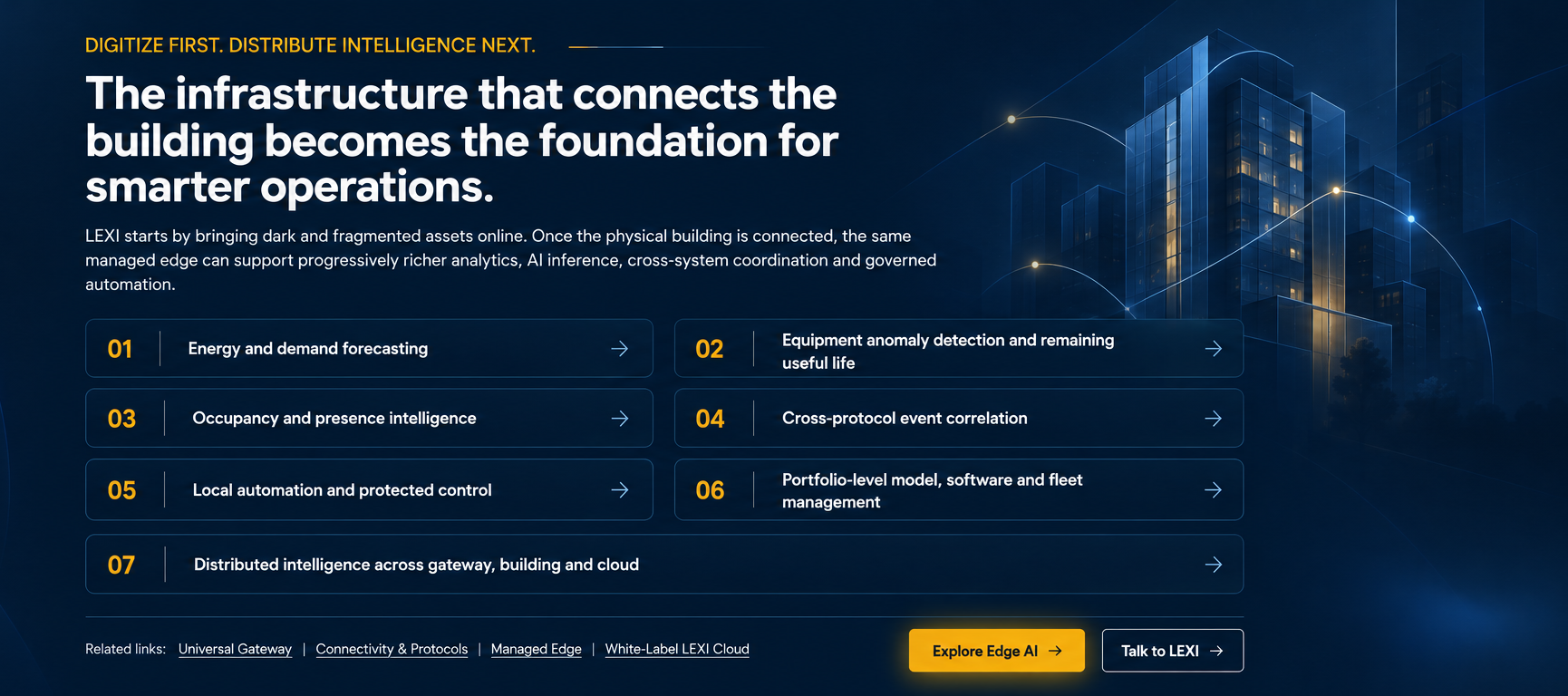
Digitize first. Distribute intelligence next. The infrastructure that connects the building becomes the foundation for smarter operations. LEXI starts by bringing dark and fragmented assets online. Once the physical building is connected, the same managed edge can support progressively richer analytics, AI inference, cross-system coordination and governed automation: energy and demand forecasting; equipment anomaly detection and remaining useful life; occupancy and presence intelligence; cross-protocol event correlation; local automation and protected control; portfolio-level model, software and fleet management; distributed intelligence across gateway, building and cloud.